





Introduction
Florence, the cultural capital of Tuscany, transforms every evening into a theater of shadows and light where history and art reveal themselves in a new way. The city, cradle of the Renaissance, isn’t just an open-air museum by day: at night, marble façades, domes and bridges tell a different, more intimate and painterly story. A nighttime stroll through Florence lets you rediscover famous landmarks — the Cattedrale di Santa Maria del Fiore (the Duomo), the Ponte Vecchio, Piazza della Signoria — bathed in the golden glow of spotlights and streetlamps, when the tourist bustle fades and the city breathes slower and deeper.
Set in the Tuscan landscape, Florence sits at the crossroads of rural scenery and urban genius. The surrounding hills, like those of Fiesole, add a sense of perspective to the night panorama. Tuscany’s mild Mediterranean climate makes these walks enjoyable most of the year, especially summer evenings when you can extend the day with a gelato or a glass of Chianti on a terrace. But Tuscany is also a way of life: take your time, observe, listen to the narrow streets, smell the aromas of kitchens spilling out of osterie and trattorie. Wandering the cobbled alleys and the banks of the Arno, you’ll understand why Renaissance artists found fertile ground for inspiration here.
This walk could begin in the heart of the historic center around the Duomo, then stretch toward the Lungarno, follow the river to the Ponte Vecchio, head back up to Piazza della Signoria and finish at the Piazzale Michelangelo viewpoint. Each stop offers its own play of light: Brunelleschi’s dome cuts through the sky like a giant lantern, the goldsmiths’ shops on the Ponte Vecchio gleam under the lights, while the statues in the Loggia dei Lanzi take on an almost lifelike presence after dark. In this article I’ll guide you through a complete night walk in Florence, giving precise addresses, usual illumination times, indicative prices for nighttime visits, and practical tips to make the most of your experience — from safety to photography to tasty rest stops. Lace up your walking shoes, grab your camera and curiosity: illuminated Florence awaits.

The Duomo and Piazza del Duomo by Night
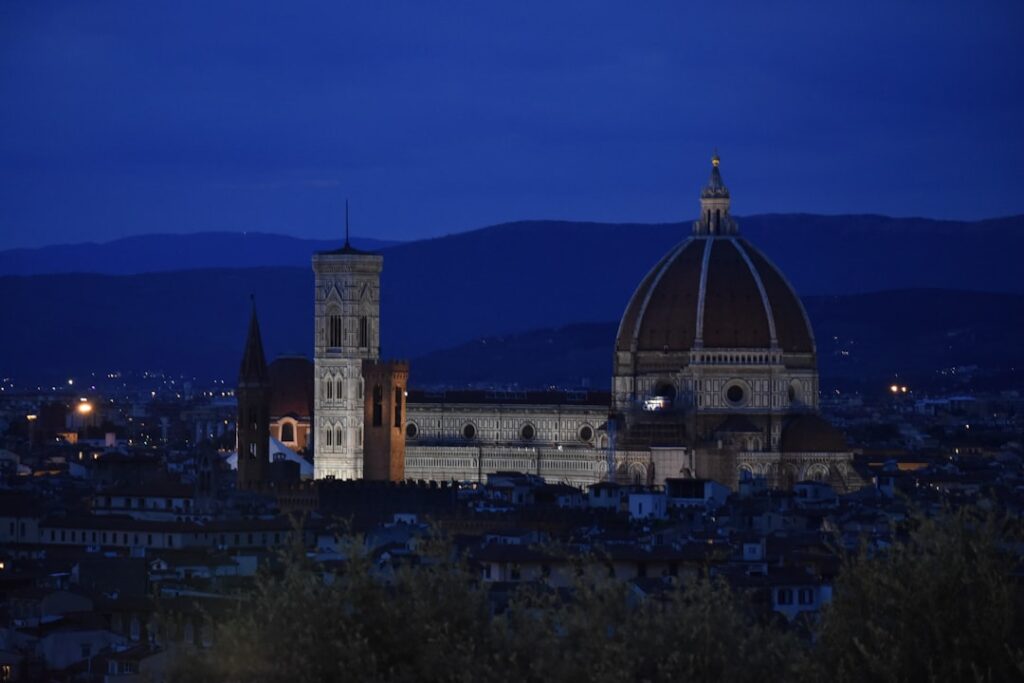
In the center of the old town, the Cattedrale di Santa Maria del Fiore (Florence’s Duomo) is one of Tuscany’s most iconic images. Address: Piazza del Duomo, 50122 Firenze FI, Italy. By day, the green, white and pink marbles dazzle; at night, the lighting sculpts the volumes and highlights the Gothic decorations and the neo-Gothic façade. The church itself is often accessible during the day for free (entry into the cathedral is free), but the whole complex (Museo dell’Opera del Duomo, Giotto’s Campanile, Brunelleschi’s Dome and the Baptistery) is managed with a combined ticket.
Booking and indicative prices: the « Duomo Pass » (access to the Dome, Campanile, Opera Museum and Baptistery) usually costs between €20 and €30 depending on the season and can be bought on site or online via the Opera di Santa Maria del Fiore. Typical hours: the cathedral is often open from 10:15 to 16:30 (hours vary), the Museo dell’Opera del Duomo: 9:00–17:30, and the climb to the Dome requires a timed reservation. At night, although the interior is closed, the square remains accessible 24/7 and public lighting showcases the dome’s silhouette — perfect for photos.
Immersive tip: arrive late afternoon to watch the shift from daylight to artificial lighting. Head up to the Oblique Café terrace (if you want a paid rooftop view nearby) or stand on Via dei Servi for a tighter angle on the façade. Note: summer evenings can draw large crowds for sunsets; in high season, opt for later hours (after 10pm) for fewer people and more calm.
Local etiquette: respect quiet and rules around religious sites (no loud music, dress modestly). If you plan to photograph with a tripod, check municipal rules — in some central areas professional equipment can be regulated. Finally, public restrooms and cafés are available in adjacent streets (espresso price standing at the counter: ~€1.20–€2.00).

Ponte Vecchio and the Lit Banks of the Arno
The Ponte Vecchio is probably the most photographed bridge in Italy. Address: Ponte Vecchio, 50125 Firenze FI, Italy. Built in the 14th century and famous for its goldsmiths’ and antique shops, the bridge reflects in the Arno at night, creating luminous compositions where golden shop windows counter the river’s darkness. The lanes along the Lungarno (Lungarno degli Acciaiuoli, Lungarno degli Archibusieri) provide complementary viewpoints, where you can sit on a bench and watch the city sparkle.
Hours and prices: the bridge is freely accessible 24/7. Shops generally open between 10:00 and 19:00; some artisan stores stay open later in high season. The luxury jewelry shops on the bridge can be pricey, but the visual experience is free. For a tasty stop, several gelaterie and wine bars are just a stone’s throw away; expect €3–€6 for an artisanal gelato and €5–€12 for a glass of wine at a local bar.
Night experience: cross the Ponte Vecchio slowly, taking in the shop windows, then continue east to the viewpoint in front of Ponte Santa Trinita — from there you’ll see three bridges aligned and streetlights mirrored in the water. The low-angle light on the façades of the Lungarno palazzos creates tableaux that change with every step. For photographers, use a slow shutter and a tripod (respecting local regulations) to capture reflections.
Local tip: beware of pickpockets in very busy evening areas. Prefer a zipped bag and keep valuables close. If you’re planning a romantic dinner, book a table with an Arno view at least a day in advance in summer; popular Lungarno restaurants like Ristorante La Giostra (address: Borgo Pinti 10/12R — check menu and booking) often fill up quickly.
Piazza della Signoria, Palazzo Vecchio and Art Under the Stars
Piazza della Signoria is Florence’s civic heart and an open-air museum where statues take on a new scale at night. Address: Piazza della Signoria, 50122 Firenze FI, Italy. Dominating the square, the Palazzo Vecchio (address: Piazza della Signoria, 50122 Firenze) is open to the public and often offers occasional evening openings. Usual hours: Palazzo Vecchio — 9:00–19:00 (closing times vary with events), admission around €12–€16. The Loggia dei Lanzi displays outdoor sculptures, including the famous copy of Michelangelo’s David (the original has been moved) and Benvenuto Cellini’s Perseus with the Head of Medusa.
As night falls, the square takes on a different energy: fewer cars, more strollers and sometimes street musicians adding a warm soundtrack. Lighting emphasizes the sculptures and the medieval façade of the Palazzo Vecchio, giving the place a theatrical feel. Behind the palace, entry to the Museo di Palazzo Vecchio grants access to historic rooms, and Arnolfo’s tower offers panoramic nighttime views of the center (the climb is paid and usually requires a reservation). Tour prices and opening times vary; count about €8–€10 for access to certain sections.
Visiting tip: if you want a guided night tour, check special events organized by the Comune di Firenze or the civic museums network. Themed evening tours (Florentine republic history, Renaissance frescoes) are often scheduled and should be booked in advance. Bring a small flashlight to read explanatory panels in dimly lit areas, and take time to study architectural details — the stonework, coats of arms and visual axes — which tell centuries of stories.
Romantic Walk to Piazzale Michelangelo and the Boboli Gardens
To end an evening beautifully, make your way to the Piazzale Michelangelo, Florence’s must-see panoramic spot. Address: Piazzale Michelangelo, 50125 Firenze FI, Italy. This viewpoint, reachable on foot (about 20–30 minutes uphill from the Ponte Vecchio) or by bus (ATAF lines), offers breathtaking views of the cathedral, the Arno, Palazzo Vecchio and the red-tiled roofs washed in nightlight. Piazzale is open 24/7 and free; it’s very popular at sunset but remains magical after dark when the city stretches below like a carpet of stars.
Just below, the Giardino di Boboli (address: Piazza Pitti, 1, 50125 Firenze FI) is a vast Italian garden behind Palazzo Pitti. Typical hours: Boboli Gardens usually open from 8:15 to 16:30 or later depending on the season; admission roughly €10–€12. Most gardens close in the evening, but the walk up to Piazzale Michelangelo via small streets and stairways offers romantic stops — benches, tiny viewpoints and partial city vistas. Boboli’s sculptures and grottoes are especially photogenic in evening light if nighttime openings are organized during cultural events.
Romantic tips: bring a small blanket and a bottle of wine if you plan to linger at Piazzale (respect public cleanliness rules and don’t leave anything behind). Couples like western-facing angles to see the Duomo silhouette and the Ponte Vecchio. If you prefer dinner before the climb, the Oltrarno district (west bank of the Arno) is full of osterie and traditional restaurants, especially around Borgo San Jacopo and Via de’ Bardi. Expect a full meal to cost between €20 and €50 per person depending on the level of the restaurant.

Practical Tips for a Night Walk in Florence
Walking in Florence at night is generally safe, but as in any major tourist destination, a few simple rules will maximize enjoyment and safety. First, choose comfortable shoes: cobbles (sassi) and old steps are uneven and can be slippery when wet. Carry a small flashlight or use your smartphone lamp for dim alleys. Shops and cafés often close between 22:00 and 24:00 depending on the season; public transport (ATAF buses) runs less frequently at night. Taxis are available but better booked via an app or from an official stand (expect a night surcharge).
Money and payments: many small businesses accept cards, but it’s handy to have some cash for small purchases (a gelato, an espresso at the counter). ATMs (bancomat) are plentiful, especially around Santa Maria Novella and the Duomo. If you want to attend museum late openings or church concerts, book tickets online (Uffizi, Galleria dell’Accademia) to avoid queues — Uffizi tickets cost around €20–€25, usual hours: 8:15–18:30, closed on Monday.
Photography: the best night shots require stability — use a light tripod if you have one, or stabilize your camera on a wall. Respect no-photography areas (some exhibits may prohibit it) and ask permission for professional use. Finally, engage with locals: a waiter, an artisan or a guide can share a historical angle that will enrich your evening.

Conclusion
A night walk in Florence is a full sensory experience where art and history take on a new dimension. From the illuminated majesty of the Duomo on Piazza del Duomo, to the romantic reflections of the Ponte Vecchio on the Arno, through the solemn nighttime mood of Piazza della Signoria and the panoramic view from Piazzale Michelangelo, every stop offers fresh perspectives and heightened emotion created by light and silence. Florence, at the heart of Tuscany, invites a slow-travel approach: let your steps lead you, listen to the city, savor an artisanal gelato or a glass of local wine and soak in an atmosphere that blends heritage with everyday life.
To get the most out of this experience, do a little planning — check museums and site hours, book tickets for visits that interest you (Dome, Uffizi, Palazzo Vecchio), and adapt your itinerary to the season. Don’t forget the practical tips: proper shoes, watch out for pickpockets, respect historic sites and, if you’re photographing, be mindful of regulations. And, importantly, leave room for the unexpected: a small trattoria, a street concert, a lit side street can turn a walk into an unforgettable memory.
Florence by night is a mirror of Tuscany: at once solemn and lively, historic and intimate. Whether you’re an art lover, a photographer, a traveler seeking romance or simply curious, the illuminated city promises pages of history to read by lamplight. Plan your route, but allow yourself to wander and get lost — it’s often down a side street that Florence reveals its most beautiful secrets.